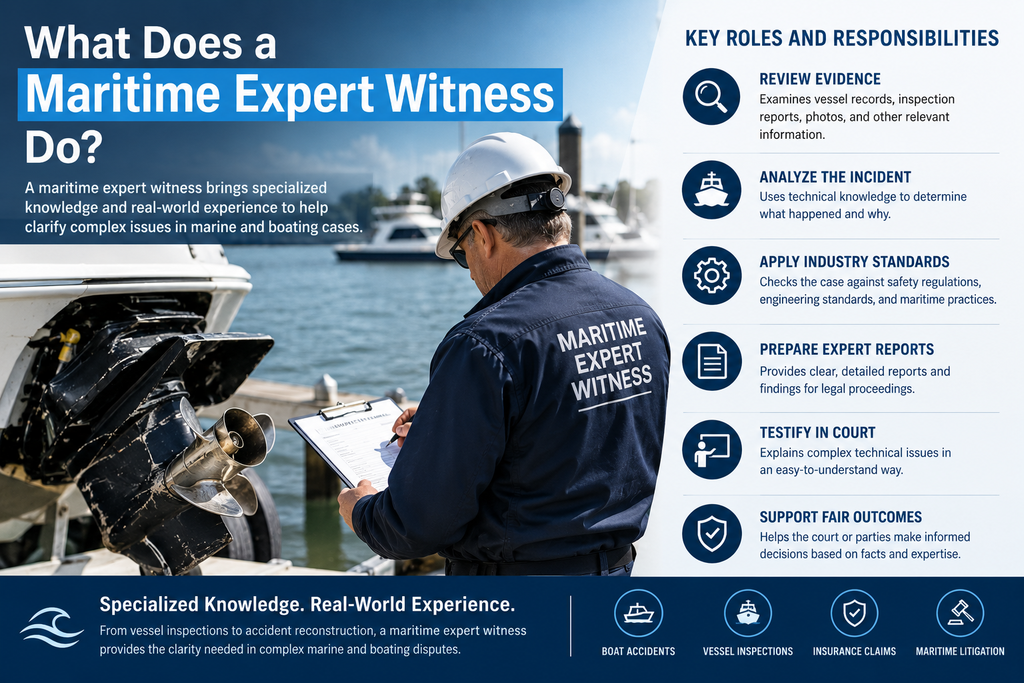
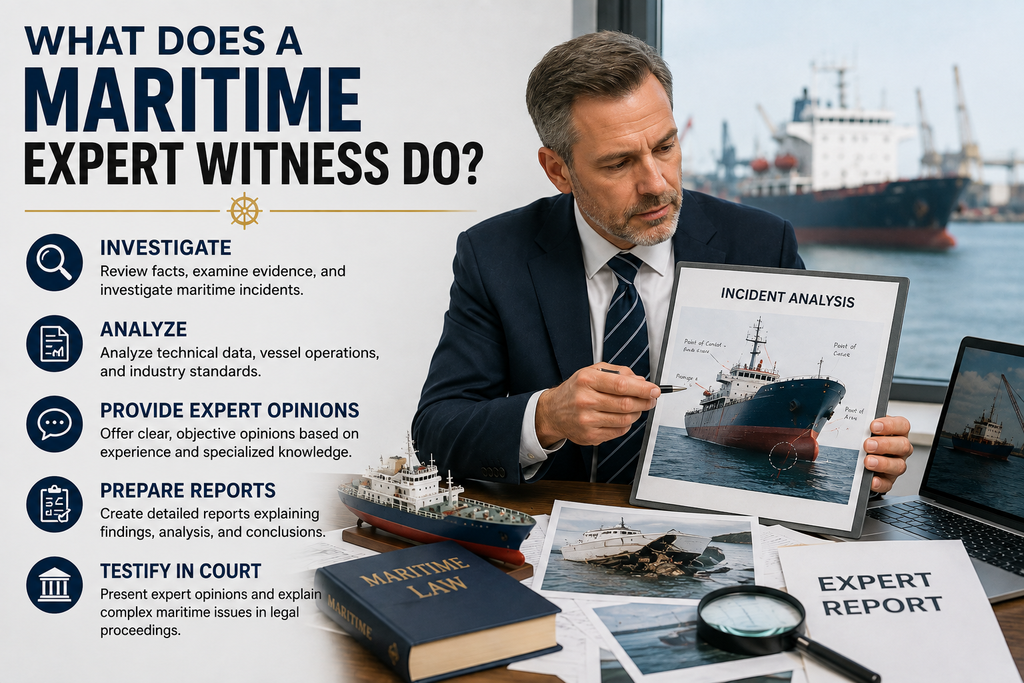
What does a maritime expert witness do? A maritime expert witness uses specialized marine knowledge and practical experience to investigate technical issues, analyze evidence, form independent opinions, prepare reports, and explain complex maritime matters to attorneys, insurers, judges, juries, arbitrators, or other decision-makers.
The work can involve much more than appearing in court. A maritime expert witness may inspect a vessel, reconstruct an accident, examine navigation decisions, analyze machinery failures, review maintenance records, evaluate vessel condition, study electronic navigation data, and determine whether the available evidence supports a particular explanation of an incident.
Under Federal Rule of Evidence 702, an expert may qualify through knowledge, skill, experience, training, or education when specialized knowledge will help the trier of fact understand evidence or determine a fact in dispute. The rule also requires sufficient facts or data, reliable methods, and reliable application of those methods to the case.
That combination of maritime experience, technical analysis, and clear communication is what separates an expert witness from an ordinary fact witness.
What Does a Maritime Expert Witness Actually Do?
A marine expert witness turns complicated technical information into a clear explanation of what the evidence shows.
Depending on the dispute, the expert may:
- Inspect the vessel and damaged components
- Review physical and documentary evidence
- Analyze vessel operations and navigation
- Evaluate machinery or structural failures
- Reconstruct the sequence of events
- Assess human and environmental factors
- Review applicable maritime safety standards
- Develop an independent technical opinion
- Prepare an expert report
- Give deposition or courtroom testimony
The Institute of Marine Engineering, Science and Technology explains that maritime experts are used in matters ranging from vessel collisions and cargo damage to onboard fires, salvage, and environmental assessments. It also stresses that an expert’s responsibility is to provide an objective professional opinion rather than simply support the position of the party who retained them.
For cases requiring technical marine support, A&L provides dedicated Marine Legal Expert services that connect maritime investigation with litigation support.
When Is a Maritime Expert Witness Needed?
An attorney or insurer may need a marine expert witness when important facts depend on specialized maritime knowledge that a judge, jury, or legal team cannot reasonably be expected to possess.
Typical matters include vessel collisions, allisions, groundings, fires, explosions, flooding, machinery failure, propulsion failure, structural damage, cargo disputes, vessel condition disputes, personal injury claims, wrongful death matters, navigation disputes, maintenance questions, and regulatory compliance issues.
An expert may also become important when both sides agree about the basic event but disagree about why it happened.
For example, everyone may agree that two vessels collided. The disputed questions may be:
Which vessel created the collision risk?
Was a proper lookout maintained?
Was either vessel traveling at an unsafe speed?
What did the radar information show?
Were appropriate collision avoidance actions taken?
Did equipment failure contribute?
Were visibility, current, wind, or sea conditions significant?
Did the vessel operator follow accepted navigation practices?
These are technical questions. They require analysis rather than assumption.
What Evidence Does a Maritime Expert Witness Review?
Strong expert testimony starts with strong evidence.
ForensisGroup identifies vessel logs, voyage records, maintenance records, inspection reports, navigation information, incident reports, crew records, weather information, photographs, videos, communications, safety documentation, expert reports, and deposition testimony among the materials maritime experts may review.
The exact evidence depends on the case.
Vessel Logs and Operating Records
A vessel’s records can help establish what happened before, during, and after an incident.
A maritime expert may examine deck logs, engine logs, maintenance logs, voyage plans, operating procedures, repair records, inspection reports, crew assignments, and safety documentation.
The expert does not simply collect these documents.
The expert compares them.
A log entry may be tested against electronic navigation data. A reported machinery condition may be compared with maintenance records. A claimed sequence of events may be checked against photographs, timestamps, communications, and physical damage.
This comparison can expose inconsistencies or strengthen an explanation that matches the evidence.
AIS, GPS, VDR, Radar, and Navigation Data
Electronic records can become especially important in collision and navigation cases.
Depending on what the vessel carries and what information remains available, an expert may review Automatic Identification System data, GPS information, Voyage Data Recorder information, radar records, ECDIS information, chartplotter records, engine data, alarms, communications, vessel heading, speed, course, and position information.
This information can help reconstruct vessel movements and establish the sequence of events.
For collision matters, the U.S. Coast Guard Navigation Rules require vessels to maintain a proper lookout and use appropriate available means to assess collision risk. Rule 7 specifically addresses proper use of operational radar when fitted, including radar plotting or equivalent systematic observation.
Electronic data therefore becomes more than a map of where a vessel traveled. When properly interpreted, it can help an expert evaluate whether the actions taken were consistent with the circumstances.
Maintenance and Inspection Records
Maintenance records often become critical when a case involves equipment failure, vessel condition, seaworthiness, or allegations of improper upkeep.
An expert may compare the damaged component with:
Service history
Repair invoices
Prior marine surveys
Manufacturer recommendations
Inspection findings
Replacement records
Operating hours
Previous failures
Maintenance logs
A failure that looks sudden may have developed gradually. On the other hand, an older component does not automatically prove that maintenance caused the incident.
The expert must determine which explanation fits the physical evidence, operating history, and documented vessel condition.
Photographs, Video, and Physical Evidence
Physical evidence can tell a different story from written statements.
Impact marks, fracture patterns, deformation, burn patterns, corrosion, damaged machinery, structural cracking, failed components, water intrusion, and other conditions can help identify where damage began and how it progressed.
Photographs and video also preserve vessel conditions that may disappear after repairs, cleanup, disassembly, or salvage.
This is why early evidence preservation matters.
A&L’s Maritime Incident Investigation service addresses vessel condition, operational practices, environmental conditions, physical evidence, and technical factors when examining marine casualties.
Weather and Environmental Evidence
Weather can play a major role in marine incidents.
An investigation may examine wind, waves, visibility, current, tide, precipitation, sea state, navigational hazards, and other environmental conditions.
These factors should not be considered in isolation.
An expert may compare them with vessel speed, heading, maneuverability, navigation decisions, and the operator’s actions at the relevant time.
Witness and Crew Information
Witness statements can provide valuable information, but memory can be incomplete.
A maritime expert may compare witness accounts with objective evidence such as electronic navigation records, vessel logs, photographs, damage patterns, weather information, and timestamps.
This does not mean the expert decides who is telling the truth.
The expert evaluates whether a technical explanation is consistent with the available evidence.
How Does a Maritime Expert Analyze Accident Causation?
One of the expert’s most important tasks is determining how an incident developed.
Marine accidents rarely result from one isolated fact.
A collision may involve navigation decisions, visibility, vessel speed, lookout practices, radar use, equipment condition, communication, and human factors.
A machinery failure may involve maintenance history, component condition, operating loads, lubrication, cooling, corrosion, manufacturing issues, or an external event.
The investigation should therefore move through a logical sequence:
Evidence → event sequence → damage mechanism → contributing factors → technical opinion
The expert may begin by creating a timeline.
They then compare vessel movement, physical damage, records, electronic data, witness information, weather, machinery condition, and other evidence.
Alternative explanations should also be considered.
A credible expert does not choose an answer first and search for evidence that supports it. IMarEST specifically emphasizes keeping an open mind and allowing the assessment of evidence to determine the opinion.
For incidents that require a detailed reconstruction of vessel movement and damage, A&L’s Accident Reconstruction services examine physical evidence, vessel damage, environmental conditions, technical factors, and the chronology of events.
How Are Vessel Condition and Mechanical Failures Evaluated?
Not every maritime lawsuit centers on navigation.
Some depend on the condition of the vessel itself.
A marine expert may evaluate the hull, propulsion system, marine engine, steering system, electrical system, fuel system, machinery, structural components, safety equipment, and other onboard systems.
The investigation may ask:
Did a component fail before or because of the incident?
Was corrosion relevant?
Did improper maintenance contribute?
Was there a structural defect?
Was equipment operating within expected conditions?
Did a mechanical failure affect vessel handling?
Does the physical damage support the reported sequence?
Technical inspections can add another level of detail when the answer is not visible from the surface.
A&L states that its marine work can include infrared thermal imaging, ultrasonic testing, engine computer diagnostics, and borescope inspection when appropriate. The company’s broader maritime practice is built around vessel surveying, accident investigation, engineering knowledge, and litigation support.
How Are Navigation Rules and Maritime Safety Standards Applied?
An expert witness may help explain what maritime rules and accepted practices mean in the circumstances of a particular incident.
This can involve U.S. Coast Guard Navigation Rules, COLREGs, Inland Navigation Rules, safety procedures, industry standards, company procedures, and other requirements relevant to the vessel and operation.
For example, the U.S. Coast Guard rules address:
Proper lookout
Safe speed
Risk of collision
Radar use
Action to avoid collision
Restricted visibility
The rule itself does not automatically decide liability. The expert studies how the requirements relate to the actual vessel movements, conditions, available equipment, and actions taken.
For commercial shipping matters, the International Safety Management Code may also become relevant. The International Maritime Organization describes the ISM Code as an international standard for the safe management and operation of ships and pollution prevention. Its objectives include safe operating practices, safeguards against identified risks, and appropriate safety management systems.
A competent maritime expert should apply only the standards that actually relate to the vessel, jurisdiction, operation, and disputed issue.
What Is Included in a Maritime Expert Witness Report?
A strong maritime expert report should allow another reader to understand what the expert reviewed, what method the expert used, what the evidence showed, and how the expert reached the opinion.
For retained experts in federal litigation who fall under Rule 26(a)(2)(B), the required written report generally includes the expert’s opinions and reasons, facts or data considered, supporting exhibits, qualifications, certain prior testimony history, and compensation information.
In a maritime case, the substantive technical report may also discuss:
Incident background
Vessel information
Materials reviewed
Inspection procedures
Physical evidence
Navigation data
Maintenance history
Engineering findings
Environmental conditions
Accident sequence
Alternative explanations
Applicable technical standards
Causation analysis
Expert opinions
Supporting photographs, diagrams, measurements, or exhibits
A report should distinguish the evidence, the analysis, and the opinion.
That structure improves clarity and makes the reasoning easier to examine.
What Does a Maritime Expert Do During a Deposition?
After an expert report is disclosed, opposing counsel may take the expert’s deposition.
The expert may have to explain:
What evidence was reviewed
What evidence was not available
How the investigation was conducted
Which assumptions were made
Why particular methods were used
How alternative causes were evaluated
How the final opinions were reached
The deposition also allows opposing counsel to test the expert’s qualifications, methodology, consistency, and reasoning.
Federal Rule of Evidence 705 allows an expert to state an opinion and reasons without first presenting every underlying fact, unless the court requires otherwise. The expert can still be required to disclose the underlying facts or data during cross-examination.
Preparation therefore means knowing more than the conclusion.
The expert should understand the path from evidence to opinion.
What Is the Expert’s Role in Court?
The expert’s job in court is not to become an advocate for the attorney who hired them.
The expert’s job is to explain specialized matters accurately and clearly.
A judge or jury may understand that two boats collided. They may not understand radar plotting, vessel maneuverability, propulsion failure, fracture patterns, navigation rules, engineering systems, or the technical significance of AIS information.
The maritime expert witness connects that technical evidence to understandable reasoning.
The strongest testimony usually avoids unnecessary jargon.
Instead of simply stating that a vessel operator acted improperly, the expert should explain what evidence was reviewed, what standard or practice applies, what the operator did, and why that conduct matters technically.
Clarity strengthens rather than weakens technical testimony.
What Makes Maritime Expert Testimony Admissible?
Having decades of maritime experience does not mean every opinion offered by an expert will automatically reach a jury.
In federal court, Rule 702 requires the party presenting the expert to establish that specialized knowledge will help the trier of fact, that the testimony rests on sufficient facts or data, that reliable principles and methods produced the testimony, and that the expert reliably applied those methods to the case.
The Daubert framework also places a gatekeeping responsibility on federal judges when evaluating expert testimony. The inquiry focuses on whether the opinion has a reliable foundation and is relevant to the issue before the court.
For a maritime expert, this means practical experience still needs explanation.
The expert should be able to show:
How experience applies to the specific issue
What evidence supports the opinion
What methodology was used
Why the methodology is appropriate
How the method was applied
Whether reasonable alternative explanations were considered
State courts may apply different evidentiary rules, so attorneys should evaluate the requirements governing their particular jurisdiction and case.
What Qualifications Should a Maritime Expert Witness Have?
There is no single professional title that automatically makes someone a qualified maritime expert witness.
Rule 702 expressly recognizes knowledge, skill, experience, training, or education as possible bases for qualification.
The right qualifications depend on the issue.
A navigation dispute may require substantial shiphandling or vessel operations experience.
An engine failure may require marine engineering expertise.
A structural failure may require surveying, engineering, materials, or vessel construction knowledge.
A cargo dispute may call for cargo handling and shipping expertise.
A collision may require experience with navigation, vessel operations, accident reconstruction, and the applicable Navigation Rules.
The important question is not simply, “Is this person experienced in maritime work?”
It is, “Does this person’s experience match the technical question the court needs answered?”
A&L Maritime Experts states that its work draws on more than 50 years of practical maritime experience and more than 16,000 vessel inspections, supporting attorneys, insurers, vessel owners, and government agencies in marine investigations and litigation matters.
Attorneys looking specifically for A&L’s technical witness and consulting capabilities can review its Maritime Consulting and Expert Witness services.
Why Independence and Objectivity Matter
A maritime expert can be retained and paid by one party while still maintaining an independent technical opinion.
Those ideas are not inconsistent.
Payment compensates the expert for professional work. It should not purchase a predetermined conclusion.
IMarEST emphasizes that the expert’s responsibility is to assist the court or tribunal through an objective opinion rather than serve the interests of the retaining client. It also recommends allowing the evidence to shape the opinion instead of selecting an opinion first.
That independence matters because opposing counsel may test the expert’s credibility, assumptions, methodology, compensation, prior testimony, and consistency.
An opinion that remains tied to documented evidence is easier to explain and defend.
Frequently Asked Questions About Maritime Expert Witnesses
What do expert witnesses get paid?
There is no standard fee for a maritime expert witness. Rates depend on specialty, experience, case complexity, inspections, travel, report preparation, deposition work, and trial testimony.
For general context across many expert disciplines, SEAK’s 2024 survey reported median rates of about $450 per hour for file review and preparation, $475 per hour for depositions, and $500 per hour for courtroom testimony. These figures are general expert witness benchmarks, not maritime-specific rates.
Federal Rule of Civil Procedure 26 also requires certain retained expert reports to disclose the compensation the expert will receive for study and testimony.
What are the four C’s of an expert witness?
There is no official Four C’s legal test in the Federal Rules of Evidence.
Different expert witness training and marketing sources use different versions. A commonly used framework is competence, credibility, clarity, and consistency, while some sources substitute confidence or conduct for the fourth quality.
For legal purposes, Rule 702 matters more than any Four C’s mnemonic. An expert must have relevant qualifications, use sufficient facts or data, apply reliable methods, and provide specialized knowledge that helps the court.
For practical courtroom performance, competence, credibility, clarity, and consistency remain useful qualities.
What qualifies someone as an expert witness?
In federal court, Rule 702 allows qualification through knowledge, skill, experience, training, or education.
The expert’s specialized knowledge must relate to the issue being litigated. The opinion must also rest on sufficient facts or data and reliable methods that the expert reliably applies to the case.
For maritime matters, practical seagoing experience can be particularly valuable when it directly relates to navigation, marine engineering, vessel operations, surveying, maintenance, safety, or another issue in dispute.
What are the risks of being an expert witness?
Expert witness work places professional opinions under scrutiny.
Opposing counsel may challenge the expert’s qualifications, methodology, assumptions, prior statements, publications, compensation, consistency, and conclusions. Expert opinions may also face admissibility challenges before trial.
IMarEST notes that maritime experts should expect their opinions, abilities, and motives to be challenged through detailed questioning.
For that reason, experts should stay within their actual field of expertise, preserve their independence, document their analysis, avoid speculation, and support each material conclusion with appropriate evidence.
Can a maritime expert witness determine who is legally liable?
A maritime expert can provide technical opinions about matters such as causation, vessel operations, engineering failure, navigation practices, damage, safety procedures, and compliance with relevant standards.
The expert generally does not decide the ultimate legal outcome.
The court, jury, arbitrator, or other decision maker determines legal responsibility after considering the admissible evidence and applicable law.
How early should a maritime expert witness be retained?
Early involvement can be particularly valuable when physical evidence may change or disappear.
Repairs, salvage, cleanup, vessel movement, weather exposure, data overwriting, or component removal can affect later analysis.
Retaining the appropriate expert early may allow the legal team to document the vessel, preserve relevant evidence, identify needed electronic data, and establish an investigation plan before important information is lost.
Technical Maritime Evidence Should Lead the Opinion
A strong maritime case does not need an expert who simply repeats one party’s version of events.
It needs an expert who can examine physical evidence, vessel records, navigation data, machinery condition, maintenance history, environmental conditions, human factors, and applicable maritime standards, then explain what those facts support.
That is the real role of a maritime expert witness.
For legal teams, insurers, vessel owners, or other stakeholders handling a technically complex marine dispute, A&L Maritime Experts provides vessel investigation, accident reconstruction, marine surveying, technical consulting, and expert testimony support.
For case-specific assistance, contact A&L Maritime Experts to discuss the technical issues involved in the matter.