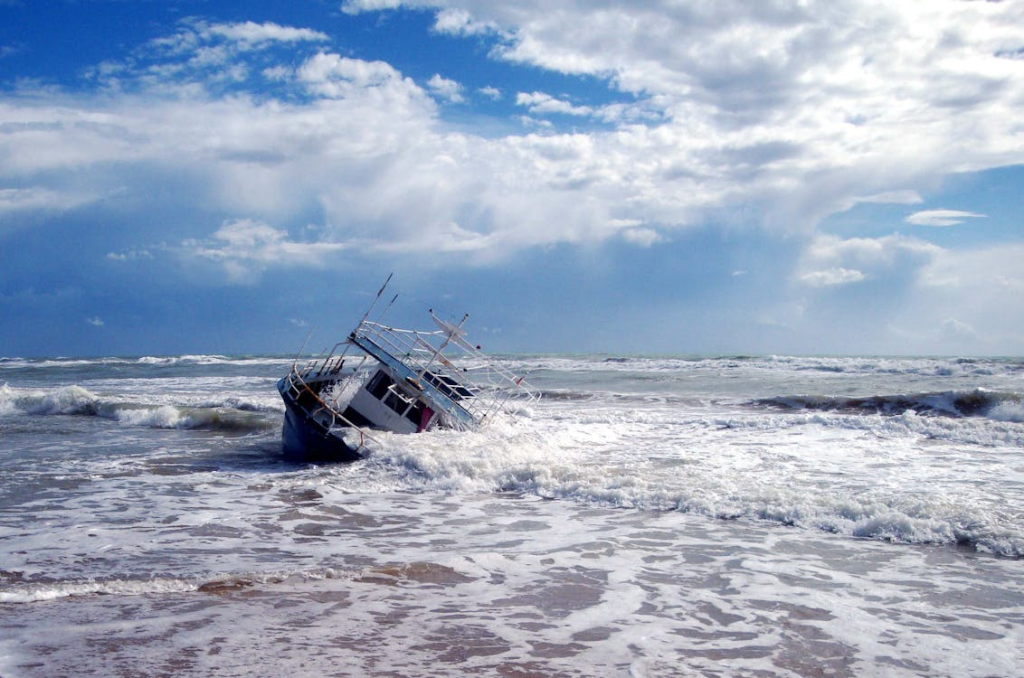
How is a vessel collision investigated? Investigators preserve evidence, inspect the vessels, collect navigation and electronic data, interview witnesses, reconstruct each vessel’s movement, examine human and mechanical factors, and compare those findings with applicable Navigation Rules. The objective is to establish a reliable sequence of events and determine which factors caused or contributed to the collision.
A proper vessel collision investigation does not begin with an assumption about fault. It begins with evidence. Investigators may compare AIS data, radar information, vessel logs, physical damage, photographs, witness statements, weather conditions, machinery condition, and navigation decisions before reaching technical conclusions.
The National Association of State Boating Law Administrators also recognizes that boating collision investigation requires both evidence analysis and an understanding of boat construction and collision dynamics.
What Is a Vessel Collision Investigation?
A vessel collision investigation is a systematic examination of the circumstances before, during, and after contact between vessels.
Investigators try to answer several connected questions.
Where were the vessels before impact?
What courses and speeds were they maintaining?
When did a risk of collision develop?
What actions did each operator take?
Was a proper lookout maintained?
Did radar or other navigation equipment provide warnings?
Did mechanical failure affect vessel control?
What do the damage patterns reveal about the point and direction of impact?
Were weather, visibility, current, or traffic conditions important?
By comparing these pieces of evidence, a marine investigator can reconstruct what happened rather than relying solely on one person’s account.
A collision should also be distinguished from an allision. Collision generally describes contact between vessels, while allision refers to a vessel striking a stationary object. NASBLA collision investigation training specifically treats that distinction as part of boating incident analysis.
Who Investigates Boat Crashes?
The answer depends on the vessel, location, severity of the incident, and jurisdiction.
For commercial vessel casualties in the United States, the U.S. Coast Guard conducts marine casualty investigations. The Coast Guard states that these investigations establish findings of fact, analysis, conclusions, and safety recommendations.
The National Transportation Safety Board can also investigate major marine accidents. The NTSB explains that the Coast Guard is typically the lead agency for marine investigations, while the NTSB may participate from a transportation safety and probable cause perspective.
Recreational boating accidents may involve state boating agencies, marine patrol units, local law enforcement, or the Coast Guard depending on the circumstances and applicable reporting rules. Coast Guard guidance recognizes both state reporting authorities and federal involvement in recreational boating accidents.
Private marine investigators, surveyors, engineers, and maritime expert witnesses may conduct separate technical investigations for vessel owners, insurers, attorneys, or other interested parties.
A&L Maritime Experts provides technical support through its Maritime Incident Investigation service when a case requires detailed examination of vessel condition, evidence, operations, and accident circumstances.
A Practical Seven-Stage Vessel Collision Investigation
There is no single federal rule establishing a universal set of exactly seven accident investigation steps. The NTSB describes its official investigation process more broadly as notification, fact gathering, analysis, final reporting, and safety recommendations.
For a technical marine collision investigation, however, the process can be understood through these seven practical stages.
- Secure the scene and preserve evidence
Investigators first identify evidence that could disappear or change. That can include electronic records, damaged components, photographs, vessel positions, debris, communications, and physical marks.
Repairs, salvage operations, vessel movement, weather exposure, cleanup, or data overwriting can alter evidence. Early preservation therefore helps protect the accuracy of later reconstruction.
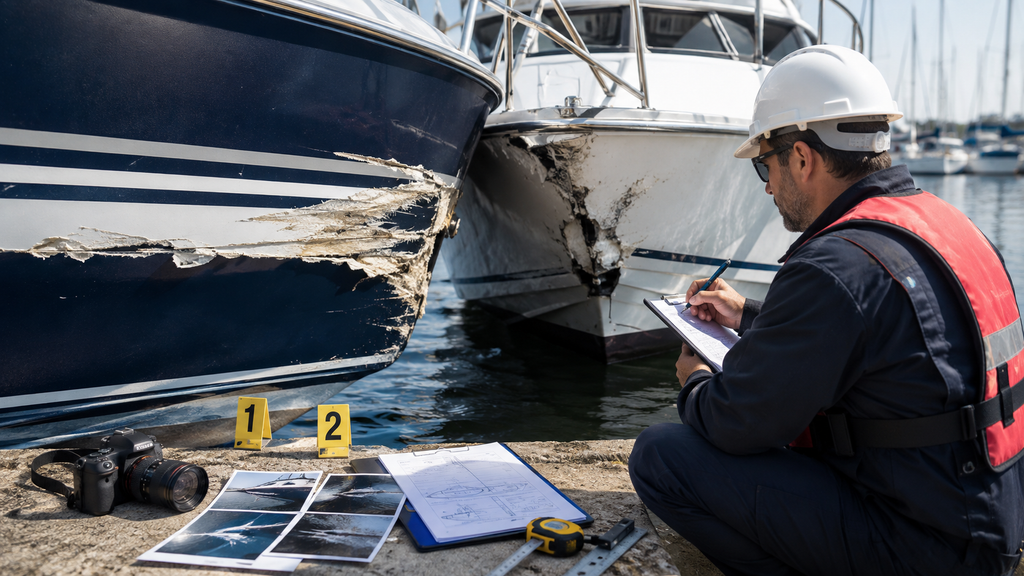
- Inspect the vessels and collision damage
Investigators examine the hull, deck, structural components, propulsion equipment, steering system, navigation equipment, and other areas relevant to the incident.
The inspection documents the location and character of impact damage.
- Collect electronic and navigation data
Available AIS, VDR, GPS, ECDIS, radar, ARPA, engine, alarm, and communication records may help establish vessel movement and operator actions.
- Gather documents and witness information
Relevant evidence can include vessel logs, voyage plans, maintenance records, crew records, photographs, videos, weather information, incident reports, and witness statements.
- Reconstruct vessel movements and collision dynamics
Investigators compare the available data to reconstruct course, speed, heading, maneuvering, relative movement, point of impact, and the sequence leading to contact.
- Analyze contributing factors and Navigation Rules
The reconstructed event is tested against lookout practices, safe speed, collision risk assessment, vessel maneuvering, human factors, mechanical condition, environmental conditions, and relevant COLREGs or Inland Navigation Rules.
- Develop findings and technical conclusions
The investigator separates established facts from analysis and explains which factors the evidence supports. The findings may become part of a marine investigation report, insurance assessment, litigation report, or expert opinion.
This evidence-led approach also reflects NASBLA guidance that investigators should weigh claims and theories against all available information rather than reaching premature conclusions.
What Evidence Is Collected After a Vessel Collision?
A collision can generate several forms of evidence, and no single source should automatically control the analysis.
Investigators commonly work with electronic evidence, physical evidence, documentary records, witness information, environmental information, and vessel system data.
The value comes from comparing these sources.
An AIS track may show where a vessel traveled.
Radar information may show how another vessel was being monitored.
Physical damage may indicate the direction of contact.
A witness statement may explain what the operator believed was happening.
Engine or steering records may reveal whether the vessel responded as expected.
When several independent sources point toward the same event sequence, the reconstruction becomes stronger.
How AIS Data Helps Reconstruct Vessel Movements
Automatic Identification System data, commonly called AIS data, can be one of the most useful electronic sources in a ship collision investigation.
Depending on the available records, investigators may use AIS information to study vessel position, course, speed, heading, and movement over time.
Historical AIS records can help reconstruct the trajectories of vessels as they approached one another and identify changes in their movements before impact. Research into collision reconstruction has specifically demonstrated the value of AIS data for examining vessel trajectories and maneuvering decisions.
AIS should still be interpreted carefully.
Investigators may need to consider transmission intervals, missing data, sensor inputs, timing, and the difference between what AIS records and what actually occurred between individual data points.
For that reason, AIS works best when compared with radar, VDR, GPS, vessel logs, physical evidence, and witness information.
What Do VDR, Radar, and ECDIS Tell Investigators?
Larger commercial vessels may provide a much richer electronic record.
A Voyage Data Recorder can preserve information relevant to vessel operation and bridge activity.
Depending on the system and incident, investigators may examine bridge audio, navigation information, vessel parameters, equipment status, and other recorded data.
Radar can help establish how nearby vessels were detected and monitored.
ECDIS records may assist in examining vessel tracks, voyage information, navigation decisions, and the bridge team’s awareness of surrounding traffic.
When investigators synchronize several electronic sources, they can build a more detailed timeline of the encounter.
The goal is not simply to determine where the vessels were.
The more important question is what information was available to the bridge team and what actions followed from it.
CPA and TCPA in Collision Analysis
Two concepts often used when analyzing collision risk are Closest Point of Approach, or CPA, and Time to Closest Point of Approach, or TCPA.
CPA estimates how close two vessels will pass if their present motion continues.
TCPA estimates how long it will take to reach that closest position.
These calculations can help investigators understand when a developing encounter became a close quarters situation and whether collision avoidance action occurred early enough.
They should not be treated as substitutes for proper navigation judgment.
The Coast Guard Navigation Rules require vessels to use all available means appropriate to the circumstances to determine whether collision risk exists. Rule 7 specifically requires proper use of operational radar, including systematic observation or radar plotting where appropriate.
How Physical Damage Reveals the Collision Sequence
Electronic evidence tells only part of the story.
The vessels themselves can preserve important information.
A post-collision inspection may document hull deformation, crushing, punctures, fractures, scrape patterns, paint transfer, structural damage, contact marks, damaged fittings, and displaced material.
Investigators examine where these marks appear and how they align.
For example, the orientation of scrape marks may help indicate relative movement during contact.
Material transfer may connect one damaged surface to another.
Hull deformation may provide information about where impact energy was absorbed.
Damage height and location may help test whether a proposed collision angle makes physical sense.
NASBLA training emphasizes that a thorough damage assessment should occur before accident analysis because incomplete inspection can miss structural damage and lead to unsupported findings.
For cases requiring detailed reconstruction, A&L’s Accident Reconstruction service combines vessel damage analysis with environmental conditions, technical evidence, and event reconstruction.
How Investigators Determine the Point and Angle of Impact
The point of impact is not necessarily established by one obvious dent.
Investigators may compare damage geometry across both vessels.
They may study contact height, paint transfer, scrape direction, hull shape, structural deformation, vessel movement, and the locations of damaged components.
The analysis must also account for vessel motion.
Unlike vehicles on a roadway, boats can yaw, pitch, roll, heel, drift, rotate, and continue moving after impact.
Water movement can also change the vessels’ final positions.
That is why the location of a vessel after the accident should not automatically be treated as its position at the moment of collision.
Collision reconstruction combines physical damage with movement data to determine whether the evidence supports the proposed impact scenario.
COLREGs and the U.S. Navigation Rules
Navigation rules are central to many collision investigations.
The Coast Guard’s current amalgamated Navigation Rules combine the International COLREGs with applicable U.S. Inland Navigation Rules.
Several rules are particularly important.
Rule 5: Lookout
Every vessel must maintain a proper lookout using sight, hearing, and all available means appropriate to the circumstances.
Investigators may examine whether the bridge team or operator was actively monitoring surrounding traffic.
Rule 6: Safe Speed
Safe speed depends on the actual conditions.
Relevant factors can include visibility, traffic density, vessel maneuverability, wind, sea state, current, navigation hazards, available water depth, and radar limitations.
Rule 7: Risk of Collision
Vessels must use appropriate available means to determine whether collision risk exists.
The rule specifically addresses proper radar use when radar is fitted and operating.
Rule 8: Action to Avoid Collision
Collision avoidance action should be positive, made in sufficient time, and consistent with good seamanship.
Rules 13 through 17 may also become important when investigators analyze overtaking, head on, crossing, give way, and stand on vessel situations.
The relevant rule depends on the encounter.
A technical investigation should therefore establish the actual vessel relationship before drawing conclusions about how a rule applies.
Why Proper Lookout Matters
A proper lookout involves more than occasionally looking out a window.
Depending on the vessel and conditions, it can involve visual observation, hearing, radar monitoring, AIS awareness, bridge teamwork, and continuous evaluation of developing traffic situations.
During an investigation, experts may examine:
Whether another vessel was detected
When it was detected
How its movement was interpreted
Whether collision risk was recognized
Whether information was communicated
Whether action followed soon enough
Failure in any part of that chain may become relevant to causation.
How Human Factors Are Investigated
Collisions are often described simply as human error, but that phrase is rarely a complete explanation.
Investigators look deeper.
They may examine fatigue, situational awareness, distraction, workload, bridge communication, training, experience, decision making, watchkeeping practices, and Bridge Resource Management.
The important question is not merely whether someone made a mistake.
Investigators try to understand why the action occurred and how it affected the sequence of events.
For example, an operator may have seen another vessel but misunderstood its movement.
A bridge team may have received radar information but failed to communicate the risk clearly.
An officer may have delayed action because the encounter appeared safe initially.
Fatigue may have reduced attention.
A weak handover between watch officers may have left the incoming officer without a complete picture of traffic.
Each of these factors requires evidence.
Mechanical Failure Can Also Cause or Contribute to a Collision
Not every collision results only from navigation decisions.
Investigators may inspect the steering system, rudder, propulsion system, engines, controls, autopilot, electrical system, and navigation equipment.
A reported steering failure should be tested against physical condition, maintenance history, alarm records, electronic data, and the vessel’s actual response.
An engine failure may affect speed or maneuverability.
A control system fault may delay a maneuver.
A propulsion problem can change what collision avoidance options were realistically available.
Investigators should therefore examine mechanical explanations rather than assuming that an operator caused every unexpected vessel movement.
Weather, Visibility, Current, and Sea Conditions
Environmental conditions can significantly change how an encounter should be evaluated.
Investigators may review visibility, fog, rain, wind, current, tide, sea state, water depth, traffic density, and available lighting.
These conditions affect both vessel handling and what should reasonably have been expected from the operator.
Rule 6 expressly identifies factors such as visibility, traffic density, maneuverability, wind, sea, current, navigational hazards, and available water depth when assessing safe speed.
The investigation therefore asks not simply, “How fast was the vessel going?”
It asks, “Was that speed appropriate for those conditions?”
How Witness Statements Are Used
Crew members, captains, passengers, nearby boaters, dock personnel, and other witnesses can provide valuable information.
Their statements can describe sounds, lights, conversations, vessel movements, equipment problems, or events that electronic systems did not record.
However, investigators should not rely on memory alone.
Statements are compared against timestamps, navigation data, vessel logs, photographs, videos, physical evidence, and other records.
If a statement says a maneuver occurred at a particular moment, electronic data may help confirm or challenge that timeline.
This comparison is especially important when different witnesses remember the event differently.
How Investigators Determine the Cause of a Vessel Collision
Causation should emerge from the evidence collected throughout the investigation.
A useful analysis separates the immediate event from the factors that contributed to it.
For example, the immediate collision may have followed a late course alteration.
The deeper investigation may show that delayed action resulted from inadequate lookout, poor radar monitoring, fatigue, unclear bridge communication, or an incorrect assessment of collision risk.
Alternatively, a mechanical failure may have prevented an otherwise appropriate maneuver.
The IMO Casualty Investigation Code reinforces this broader approach. Its objective is safety investigation and prevention rather than simply assigning blame or liability. The Code encourages investigation of causal factors and other safety risks.
For litigation or insurance work, a private expert investigation may have a different assignment, but the same principle remains useful: conclusions should follow the evidence.
What Goes Into a Vessel Collision Investigation Report?
A strong technical report should make the reasoning easy to follow.
It normally explains the incident background, evidence reviewed, vessel information, inspection findings, electronic records, witness information, environmental conditions, reconstruction methodology, relevant navigation considerations, damage findings, analysis, and conclusions.
The report should distinguish observed facts from professional interpretation.
That distinction matters in insurance claims and maritime litigation because another professional should be able to see how the investigator moved from evidence to opinion.
Attorneys and insurers dealing with technical collision disputes may also need maritime litigation support. A&L provides this through its Marine Legal Experts service and Maritime Consulting and Expert Witness service.
How Long Do Vessel Collision Investigations Take?
There is no fixed timeline for every collision investigation.
The duration depends on accident severity, vessel type, number of parties, accessibility of evidence, electronic data, laboratory work, mechanical examinations, witness availability, and the complexity of the reconstruction.
For major U.S. marine safety investigations, the NTSB states that an investigation often requires 12 to 24 months. A preliminary report may be available within weeks, while the final report includes analysis, findings, probable cause, and safety recommendations.
A private marine investigation can follow a different timeline because its scope may be narrower. A survey limited to vessel damage is different from a full reconstruction involving several vessels, electronic evidence, engineering analysis, and expert testimony.
Accuracy should take priority over an arbitrary deadline.
Why Independent Technical Analysis Matters
A collision can generate competing explanations almost immediately.
One operator may blame the other vessel.
Another may point to mechanical failure.
An insurer may focus on vessel condition.
A legal team may focus on compliance with Navigation Rules.
The role of a technical investigator is not to choose the most convenient explanation.
It is to test each reasonable explanation against the evidence.
That requires comparing physical damage, vessel movements, electronic records, human factors, machinery condition, environmental conditions, and applicable maritime standards.
A defensible conclusion should explain not only what probably happened but why the evidence supports that conclusion.
For vessel owners, insurers, attorneys, and maritime stakeholders who need an independent technical review, A&L Maritime Experts combines marine investigation, accident reconstruction, vessel assessment, technical consulting, and expert witness support.
Frequently Asked Questions
How long do crash investigations take?
Marine collision investigations vary widely. Major NTSB marine investigations often take 12 to 24 months, although private investigations may be completed sooner or may take longer depending on evidence, testing, number of vessels, and complexity.
Who investigates boat crashes?
In the United States, the investigating authority depends on the vessel and jurisdiction. State or local boating agencies may investigate recreational accidents. The U.S. Coast Guard investigates reportable commercial marine casualties, and the NTSB can participate in major marine accident investigations.
What are the seven steps of accident investigation?
There is no universal federal seven step rule for vessel collisions. A practical marine investigation normally includes evidence preservation, vessel inspection, electronic data collection, document and witness review, accident reconstruction, causation and Navigation Rules analysis, and final reporting. The NTSB’s official process is organized more broadly around notification, fact gathering, analysis, reporting, and safety recommendations.
What information is most useful in a vessel collision investigation?
Useful evidence can include AIS, VDR, radar, ECDIS, GPS data, photographs, vessel logs, maintenance records, witness statements, weather information, physical damage, steering and propulsion records, and bridge communications. The evidence available depends on the vessel and circumstances.
Can AIS prove who caused a vessel collision?
AIS can provide valuable information about vessel position, course, speed, and movement, but it should not normally be treated as the sole source for assigning causation. Investigators compare AIS with physical damage, radar, VDR, vessel records, witness accounts, environmental conditions, and other evidence.
Why is the FAA investigation question not included in this article?
FAA investigation timing relates to aviation accidents, not vessel collisions. In U.S. civil aviation, the NTSB leads accident investigations while the FAA participates in its regulatory and safety role. The NTSB states that many general aviation investigations take 12 to 24 months. Adding that topic extensively to a vessel collision article would weaken maritime search intent.
A defensible collision analysis should explain not only what happened, but also why the available evidence supports that conclusion. A&L Maritime Experts combines marine accident investigation, vessel inspection, accident reconstruction, technical analysis, and expert witness support to help attorneys, insurers, vessel owners, and maritime stakeholders understand complex collision events. If you need an independent review of a vessel collision, contact A&L Maritime Experts to discuss the evidence, investigation scope, and technical support required for your case.